Fan-Lit: 2025

Welcome Everyone!

Welcome Everyone!

Thanks for visiting my blog where I review books and stories. I am a published author and I have a Master's Degree in English and Creative Writing. Some of my favorite books are The Hunger Games series, the Percy Jackson and the Olympians series, The Great Gatsby and The Joy Luck Club. I love to read and write short stories; as well as discuss writing and literature in any medium. Hope you enjoy and feel free to comment and make recommendations.


Wednesday, December 31, 2025

"The Far Reaches" – Short Story Anthology collection by Amazon


             The Far Reaches – Short Story Anthology collection – June 27, 2023


A collection of six short stories by well-known authors including Veronica Roth, who also contributed to another Amazon collection of sci-fi short stories, called Forward. I enjoyed Forward very much and posted a review for two of the stories, one of which was “Ark” by Veronica Roth and “Emergency Skin” by N. K. Jemisin. Having enjoyed those stories, I was looking forward to reading The Far Reaches, or better yet, listening to it on Audible. The six stories are:

1.      “How It Unfolds” by James S. A. Corey

2.      “Void” by Veronica Roth

3.      “Falling Bodies” by Rebecca Roanhorse

4.      “The Long Game” by Ann Leckie

5.      “Just Out of Jupiter’s Reach” by Nnedi Okorafor

6.      “Slow Time Between the Stars” by John Scalzi

The first story by James S. A. Corey (author of The Expanse) “How It Unfolds” is about a man who is searching for meaning and love while on a mission that requires him to duplicate and replicate himself, and others, throughout the galaxy in order to successfully colonize and repopulate humanity on other planets. In doing so, the team is precise about data transfer but unclear as to how many duplicates of themselves exist throughout space. The main character Roy has to work with his ex-wife and wants to rekindle their relationship, but finds that the past can’t be changed and that forward is the only way for him to live life. There is a slight plot twist at the very end, but doesn’t really affect Roy’s choices. While I was reading this story and several in the collection, two TV shows came to my mind, The Expanse, and Ascension. Given that Corey wrote The Expanse books, it makes sense why the space sci-fi elements felt similar and gave the story a familiarity that was engaging.

While I have not read Roth’s well-known series “Divergent” I have now read two science fiction short stories by her that I have loved. “Void” is a murder mystery set on a space cruise ship and it’s being investigated by a young woman named Ace who is a maintenance worker. The story is just as much about Ace as it is the mystery. Ace is sarcastic, sassy and smart while maintaining a semi distant persona from her co-workers. I also relate to her watching crime shows. The space travel ship setting reminds me of the short lived show Ascension, which was also about a murder on a space cruise ship. What I like here is that Roth addresses the issue of relative age and time in terms of space travel. The people on the ship age in relation to the time they’ve been on the ship, rather than time passing on Earth. This age difference comes into play at the end of the story when we find out who is the killer. Roth writes with such detail and character that it feels like I’m watching a movie play out. In fact I wish this story was a full length novel. Is it a bit cliché at times? Yes, but that’s not always a bad thing, and here I think it works in order to keep the story short and plot moving forward. With two excellent short stories, I might consider reading “Divergent”.


The third story in the collection is “Falling Bodies” by Rebecca Roanhorse. I also really enjoyed this story because of the pacing and how the character moves through the plot. Ira is a young man that got in trouble and has had some strings pulled so that he can be hidden away at a college. We learn how he got into trouble and that he is the adopted son of a senator of a different race called the Genteels. However, Ira is human and is against the oppression of his people. While trying to lay low he meets a girl that causes him to break a rule and maybe turns out to be something more than she appears. While I did enjoy this story, I do think it lacks details about the conflict between the two races. There wasn’t enough substance to trigger an emotional reaction towards the ending. The interest comes from the world building and the characters.

Story number four is “The Long Game” by Ann Leckie and actually reminds me of the N.K. Jemisin story “Emergency Skin” from the previous Forward collection. This series and this story and the last remind me of the Brandon Sanderson sci-fi novel Skyward. This story is about an alien slug that contemplates his life amongst his planet being colonized by humans. I didn’t love this one, it just didn’t capture my attention, and I found myself tuning out a bit. Unlike “Emergency Skin” which I did love, so go read that instead.


“Just Out of Jupiter’s Reach” by Nnedi Okorafor was a slow burn for me. At first, I didn’t know what was going on, but as the story unfolds it starts to paint a broader picture about the main character, Tornado. This story is about a future where space pilots/explorers are bonded to organic spaceship lifeforms and given five-year missions in space where they are in solitude. After five years, Tornado and the other six explorers get to meetup for a week to exchange information and reconnect with humanity. This meetup shows the negative effects isolation has on people and the importance of human bonding and companionship. While I do enjoy this one, I wish we got an explanation for the sentient organic spaceships that can create different spaces and aspects within the ship. There also wasn’t enough about the actual explorations that the crew has discovered. However, the human drama and revelations of the characters was compelling enough to hold the interest.

The last story is “Slow Time Between the Stars” by John Scalzi. This story is about an A.I. spaceship that is on a mission not explore the universe for habitable planets for humans and spans millennia. This one also remind me of the A.I. spaceship from Skyward. I didn’t love this one, it felt more like a historical text than a character point of view. I did find it fascinating that the A.I. can literally watch a planet for hundreds of years, and also still assume that humans haven’t died off yet by the time it finds a habitable planet. Also in the end it does find a perfect planet but decides people aren’t good enough for it and moves on. The story says a lot about the lack of respect and awareness humans have towards Earth and other lifeforms that we share the planet with. This is the kind of story where I can see some sci-fi fans will love it, but for me it just didn’t capture my attention and engage me emotionally nor fantastically.

Overall, I really liked or loved 4 out of the 6 short stories in this collection. I love the focus on space science fiction. Some of the stories focus more on the character’s story with a space background and others are about the exploration of galaxies. My favorite story was “Void” by Veronica Roth and my least favorite was “The Long Game” by Ann Leckie, and even that had an interesting point of view.


Review of "Forward" Short Story Collection

Review of "Ark" by Veronica Roth

Review of "Emergency Skin" by N.K. Jemisin

Tuesday, December 16, 2025

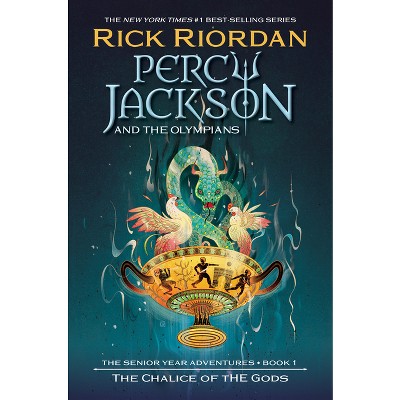
Review of "Percy Jackson and the Olympians: The Chalice of the Gods" by Rick Riordan

Review of Percy Jackson and the Olympians: The Chalice of the Gods - By Rick Riordan


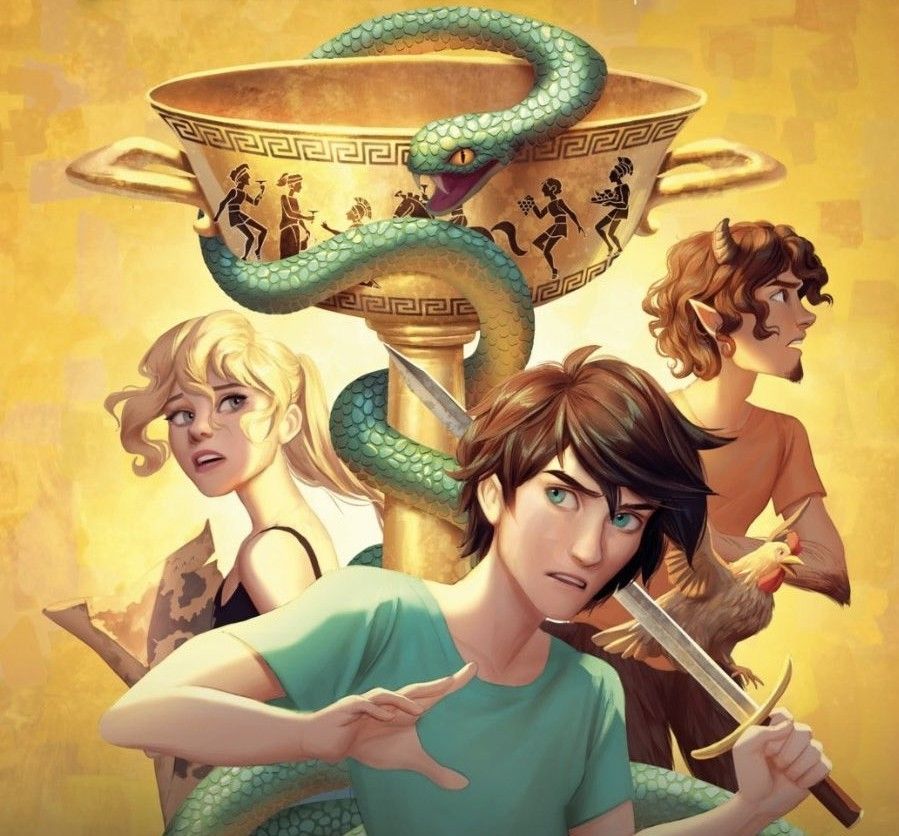
Rick Riordan’s The Chalice of the Gods marks a nostalgic return to a Percy Jackson proper book. This novel, set after the original five-book series, follows Percy during his senior year of high school and sets up a new trilogy of books. The setup is that to get into the same university as Annabeth, Percy must earn three letters of recommendation from a god. First quest is retrieving Ganymede’s chalice, because the cup bearer must have it before Zeus requests his presence on Olympus.

While I was really looking forward to reading a new adventure with Percy, Annabeth and Grover, this was a bit of a miss for me. Although I like the catalyst for a new trilogy of books – Percy needs letters of recommendations – the problem is the quests have low stakes. Instead of feeling like an epic continuation to the original five books, Chalice of the Gods feels more like a side quest. Similar to a chapter out the The Demigod Files book.

The mystery of who stole Ganymede’s chalice isn’t that exciting and the reveal is underwhelming. At no point do I feel like Percy is in any real danger, and there’s no stakes if he fails the quest. There’s no emotional attachment to the outcome and resolution to Percy succeeding. That’s the biggest problem that I have with this book, because otherwise I enjoy catching up with familiar characters. A minor complaint is the book doesn’t take place or even mention Camp Half Blood which was a cornerstone of the original books.

On to what I enjoyed. I really liked catching up with Percy in his senior year at a new high school. We get a lot of scenes of Percy living at home with his mom, Sally, and stepdad Paul. I love seeing the day-to-day life and building relationships between characters. We also get to see Percy and Annabeth as boyfriend-girlfriend, which is sweet, but at times annoying how much he refers to her as his girlfriend. Also, Annabeth feels a bit different from the original books, but that could be because she has matured. Grover is still Grover and we get some mentions of his girlfriend Juniper. It’s honestly just really nice to be back with the trio on a new adventure.

As for new characters, we meet a few new gods and one new demigod. We meet Ganymede the cup bearer to the gods, Iris the messenger goddess, Ellison a river god and Gary the god of old age. The new gods are fine and of course have heard of Percy. But it don’t have any real effect on the overall Percy Jackson universe. We’ll see if they appear in future books. Iris seems like she could be an interesting god and foil for the trio going forward. Similar to Hera or Aphrodite in the original series. Blanche is the demigod daughter of Iris and we only get a brief meeting with her. She’s into photography and is, as Grover describes her, so cool’. I wish we got more with Blanche, she seems like she could be an interesting new demigod, with her mellow/earthy vibes. Maybe she’ll return in another book.

Overall, I really enjoyed this book as a side quest adventure but wish that it had stakes with real consequences. I love returning to this world and seeing the trio interact again. We also get a bit more interaction with Percy and Poseidon, which is sweet. Not sure where this new trilogy of books is going to go, but I wish Chalice of the Gods had built up a more interesting arc to look forward to reading.


Monday, October 20, 2025

Review of “All Good People Here” by Ashley Flowers


Review of “All Good People Here” by Ashley Flowers


“All Good People Here” follows Margot Davies, a journalist who returns to her hometown of Wakarusa, Indiana, to live with her uncle, who lost his wife and is experiencing dementia. The town is still haunted by the unsolved murder of her childhood neighbor, January Jacobs. When a young girl from a nearby town goes missing under similar circumstances, Margot is drawn into the mystery, determined to uncover the truth behind both cases. But as she digs deeper, she faces resistance from the town and even her uncle.  

Ashley Flowers is the host of a very popular true crime podcast called “Crime Junkies”, which I listen to and enjoy. Flowers has a passion for crime stories, and the book often feels like an episode of the podcast. The plot is clearly inspired by and at times too similar to the well-known JonBenet Ramsay case. The main character, Margot, is a generic yet plucky character who needs to solve the case to keep her job.

While the story employs familiar elements, such as the girl who returns to her hometown to solve a mystery, interconnected timelines of present and past, and introduces several red herrings. However, it raises doubts about several characters, keeping you intrigued enough to continue reading. Just when you think you have figured it out, there’s a plot-twist.

Flowers uses dual timelines to create a suspenseful narrative that reveals information as needed that keeps the story flowing. Her background in true crime shows in the story’s realism and procedural detail. At only 312 pages, the book is well-paced and easy to read.

The main problem comes with the ending. It’s abrupt and does not provide concrete answers, leaving the main character fate ambiguous. There is also a lack of overall character development throughout the book. While Margot does learn information that could affect her life, the ending means we’ll never know how she deals with it.

Overall, though I found it a breezy murder mystery/thriller, it reminds me of an episode of a true crime podcast.  It’s not the most original story, and the ending is lacking, but if you’re a fan of true crime, then I’d recommend giving it a read. “All Good People Here” is a chilling, twist-filled thriller that questions whether or not you really know the people you trust.


Friday, April 18, 2025

Review of “Sunrise on the Reaping” by Suzanne Collins

 Review of “Sunrise on the Reaping” by Suzanne Collins


Unlike its predecessor, “The Ballad of Songbirds and Snakes,” this prequel novel, “Sunrise on the Reaping,” is more in line with the tone and themes of the original trilogy. One of the problems with both prequel novels is that we know the protagonist will survive, which lowers the personal threats and stakes. However, the power of a prequel lies in filling in the gaps in our hero’s stories. Even though we know what becomes of Haymitch from the original trilogy, we don’t know why. “Sunrise on the Reaping” is about Haymitch’s journey from just a kid in love in District 12 to Hunger Games tribute and victor. The very last few chapters of the book explain why he ends up a lonely drunk, and the reason for it is heartbreaking.

Much like the first book, “The Hunger Games” - which follows Katniss’ journey into the arena - this book follows Haymitch’s. The first chapter shows us his life as a 16-year-old boy in District 12. We meet his brother, mother and girlfriend, Lenore Dove. This book also shows us the teenage versions of Katniss’ parents, whose names we find out are Burdock and Astrid. We also learn that Reaping Day is Haymitch’s birthday.

In “Catching Fire,” we learned a little bit about how Haymitch won the 50th Hunger Games or the second quarter quell, which had twice as many tributes. This book tells us about all the behind-the-scenes things that Katniss and Peeta didn’t get to see in the tapes that the Capitol edited. In the book “Mockingjay,” Haymitch tells Katniss that after he won his games, his family and girlfriend were killed. The ending of this book explains exactly how that happened and that Haymitch blames himself because he went against President Snow.

One thing this book does that “The Ballad of Songbirds and Snakes” does is reference the original trilogy A LOT. At times it feels like “member berries”. As in, ‘remember this, remember them, look at this. It’s from the original books.’ Other than Haymitch, we meet several younger versions of characters from the previous books; some feel more shoe-horned than others. While it does make sense that Haymitch would meet previous victors during his time in the Capitol, it feels a bit overstuffed.

I wish we met and got to know more new characters. The only new character we get to know is Masilee Donner, who was Katniss’ mother’s friend. Masilee is mostly well-developed and comes across as brash and rude, but she has deeper emotions that she dislikes sharing. The evolving friendship with Haymitch is well done, and in the end, we know there is only one victor, so it’s sad knowing she won’t make it out.

We also meet a middle-aged President Snow and learn that he has been manipulating the Hunger Games tributes and victors from the beginning. Something that started when he mentored Lucy Gray in “The Ballad of Songbirds and Snakes”. Besides Haymitch, we meet another victor that Snow punishes for going against the Capitol. Much like the original trilogy, Snow isn’t present in the book much, but his presence looms largely over Haymitch.

The title of the book also serves as the theme, meaning that there will also be a sunrise on the reaping because the Hunger Games will always continue. Despite the efforts of Haymitch and other tributes to take down the Capitol, President Snow can manipulate the footage of the hunger games to show only what he wants . As well as kill whoever he needs to in order to keep Haymitch and other victors quiet and subdued. It’s actually a very tragic book, more so than the original trilogy. Especially since we know that it doesn’t stop until we get to Katniss in “Mockingjay”.

One thing this book does, is make me want more prequel books exploring other characters backstory. I would love to read Finnick’s story or Mags. I think a prequel about Mags could be unique because by the time she dies in “Catching Fire” she’s as old as President Snow. Meaning she was born before there were Hunger Games. This book confirms that she won the 11th Hunger Games, so she might have known the young Snow. Her book could span decades of Hunger Games history. As well as how she mentored Finnick.

Overall, I really liked this book; it’s better than “The Ballad of Songbirds and Snakes” in the sense that I think it has better pacing and narrative structure. I do think it goes a bit overboard with all of the younger versions of characters we know. I like seeing more of the behind-the-scenes of how the Capitol runs or manipulates the Hunger Games. Seeing a version of Haymitch that isn’t a hardened drunk is nice. We get to see how much he cares for the people he loves, and how he used to be a decent guy just trying to get back home to his family and Lenore Dove. This reminds me of a quote from “Catching Fire” when Johanna Mason says that the Capitol can’t hurt her because there is no one left that she loves. This is the lesson that Haymitch learns and turns him into the drunkard that we meet in “The Hunger Games.” However, this book ends with an epilogue that lets us know that Haymitch has accepted Katniss and Peeta as family, and he even starts to honor his long-lost love, Lenore Dove. I highly recommend reading this book if you’re a fan of the series. Even if you didn’t like the last book, this one is worth reading.


My new book is available now on Amazon https://www.amazon.com/Chimera-Prophecies-Other-Short-Stories/dp/B0C4QX4RZW/ or on the publishes website if you live outside the U.S. https://www.austinmacauley.com/us/book/chimera-prophecies-and-other-short-stories

https://www.barnesandnoble.com/w/the-chimera-prophecies-and-other-short-stories-ashlie-k-manger/1143465459