Fan-Lit: 2026

Welcome Everyone!

Welcome Everyone!

Thanks for visiting my blog where I review books and stories. I am a published author and I have a Master's Degree in English and Creative Writing. Some of my favorite books are "The Hunger Games" series, the "Percy Jackson and the Olympians" series and Brandon Sanderson's "Skyward" series. I love to read and write short stories; as well as discuss writing and literature in any medium. Hope you enjoy and feel free to comment and make recommendations.


Wednesday, August 5, 2026

Review of "The Lost World" by Michael Crichton


Review of The Lost World by Michael Crichton

The Lost World by Michael Crichton: A Disappointing Sequel to Jurassic Park

As much as I love Michael Crichton’s Jurassic Park, I was genuinely disappointed by its sequel, The Lost World. While the 1997 film The Lost World: Jurassic Park serves as a relatively straightforward continuation of the original movie, Crichton’s novel takes a dramatically different approach. Although several characters appear in both versions—including Ian Malcolm, Sarah Harding, and Eddie, with Kelly appearing largely in name only—the similarities largely end there. Unfortunately, I found the novel’s story, character development, and pacing considerably weaker than those of Jurassic Park.

A Very Different Story

The novel opens with Ian Malcolm working at a university when he encounters Richard Levine, a researcher convinced that a mysterious “lost world” populated by dinosaurs still exists. Levine also believes Malcolm’s experiences on Isla Nublar provide evidence that dinosaurs survived elsewhere.

From there, the story expands to include Dr. Jack Thorne and a group of young students who become involved in the expedition. Sarah Harding eventually joins the journey as well, following Malcolm to the island. Even Lewis Dodgson, who appeared as a secondary antagonist in Jurassic Park, returns, although his storyline feels more like a subplot than a central part of the narrative.

The problem is that there are simply too many characters and storylines competing for attention. Rather than creating a complex and engaging narrative, the multiple perspectives make the story feel scattered. Several characters lack distinct personalities, and I often found myself struggling to remember who was who or why certain characters were important.

Where Are the Dinosaurs?

One of my biggest frustrations with The Lost World is the surprisingly limited role the dinosaurs play for much of the novel. Jurassic Park succeeded because it combined scientific concepts, mystery, suspense, and genuine horror. The dinosaurs weren't simply attractions—they were an unpredictable force that constantly threatened the characters. The novel created a sense of discovery and wonder while simultaneously making readers feel that something could go terribly wrong at any moment.

The Lost World doesn't capture that same feeling. The basic premise is essentially that dinosaurs still exist and that the characters need to travel to an island to study them. But we've already been there. We already know dinosaurs exist. The mystery and sense of discovery that made the first novel so compelling are largely absent.

There was potential for a much more compelling story involving Dodgson and BioSyn attempting to obtain InGen's research and exploit the dinosaurs for their own purposes. Unfortunately, that storyline never receives the attention I expected. Instead, it feels underdeveloped and ultimately ends rather abruptly.

The Pacing and Action

Another major weakness is the pacing. Much of the novel feels slow, with relatively little action occurring until the latter portion of the story. It feel like it takes forever to even get to the island.

The trailer sequence and the shed sequence provide some of the best dinosaur suspense in the book, and these moments reminded me of what makes Crichton's dinosaur stories so entertaining. Unfortunately, they arrive too late to prevent the novel from feeling like a slog.

For a book about a group of people exploring an island inhabited by dinosaurs, I expected significantly more tension and excitement.


A More Philosophical Sequel

Interestingly, The Lost World is considerably more philosophical than Jurassic Park. Ian Malcolm spends much of the novel reflecting on chaos theory, evolution, human behavior, and the consequences of scientific advancement. Some of his observations are surprisingly relevant to modern society, particularly his thoughts about humanity's relationship with technology and our tendency to believe we can control things simply because we created them.

While I appreciated these ideas, I don't think the philosophical elements were enough to compensate for the weaknesses in the story itself. In Jurassic Park, Crichton's scientific and philosophical discussions complemented an exciting thriller. Here, they sometimes feel like they are carrying the novel while the plot struggles to keep up.

Final Thoughts

Ultimately, The Lost World was a disappointing reading experience for me. I went into it hoping for another tense, intelligent dinosaur thriller like Jurassic Park, but instead found a novel with an unfocused plot, less memorable characters, limited dinosaur action, and pacing that frequently dragged.

That's not to say the book is without merit. Crichton's scientific ideas remain fascinating, and there are several excellent suspense sequences toward the end. The novel also raises some interesting philosophical questions about science, evolution, and humanity's desire to control nature.

But compared with Jurassic ParkThe Lost World simply doesn't have the same sense of mystery, danger, or wonder. Ironically, for a novel about dinosaurs, I found myself wishing there were more dinosaurs.

If you're a fan of Jurassic Park, I would still recommend reading The Lost World at least once—particularly if you're interested in seeing how dramatically the novel differs from the movie. But if you're looking for the same combination of scientific intrigue, horror, suspense, and unforgettable dinosaur encounters found in the original book, you may find this sequel disappointing.

My verdict: A fascinating concept buried beneath a slow, unfocused, and ultimately underwhelming sequel.


Monday, May 25, 2026

Review of "Jurassic Park" by Michael Crichton

Review of "Jurassic Park" by Michael Crichton


While I am a huge fan of the movie Jurassic Park, I had never read the book, despite having a physical copy in my home. So, since the movie is one of my favorites, and I've heard about the changes made, I finally decided to get the audiobook and give it a listen. Even though I still prefer the streamlined plot of the movie, I love all of the additional characters and side plots in the book. The book actually answers several questions that the movie either never brought up or just didn't answer. 

So, the book opens with a scene that is similar to the opening of the second movie, The Lost World: Jurassic Park. The book opens with vague descriptions of strange lizards biting children in Costa Rica, and then a family goes to the beach and the girl gets attacked. We meet some characters, that don't have anything to do with the rest of the story, but it sets up this mystery of what are these creatures, and how did they get here. It's a great way to set the tone for the book, the science, the intrigue and wonder of Jurassic Park. 

The introduction to Dr. Alan Grant and Dr. Ellie Sattler is mostly the same except it's the lawyer Donald Gennaro instead of Hammond (in the movies). The movie had to streamline the characters, but the novel gives us a lot of Gennaro, and he's not the coward that he is in the movie, I actually came to like Gennaro in the book. There's a character in the book called Ed Regis, that they combined with the lawyer in the film. We also get more from Dr. Wu, Dr. Harding, Muldoon and Dr. Arnold. Showing how they run the park and control the animals. It was great getting to know these characters and their functions more. Dr. Arnold truly believed in control of the park, and Hammond is not the friendly grandpa that Richard Attenborough portrayed him as, in the movies. It was interesting learning the park systems and how everything was created and controlled.

The character of Denis Nedry also got a bit more motivation in the books, but he's still the bad guy that betrays Hammond. Although the book version of Hammond is not nice either. It's a passing line in the movie about Nedry having financial problems, but the book explains that Hammond has been overworking Nedry without compensation.

Another small change from book to movie, is Dr. Grants dislike of children. In the book, Alan Grant, loves children and has no problem taking the child under his wing to take care of them. I understand the change for the movie, they needed to give Grant character development that separates him from the others. In the book we get more of Alan, Lex and Tim's journey throughout Jurassic Park, including a scene on the river trying to escape a T. Rex. As well as a subplot about the trio discovering raptors on the boar headed for the mainland. Which is what explains how the "strange lizards" got to Costa Rica. Also in the book, Lex is not a computer nerd, but a whiny kid that loves playing ball. She gets annoying and I can see why they changed the character in the movie. 

Dr. Sattler I think has less to do in the book, but is still a decent female protagonist type. Ian Malcom is pretty much the same except he constantly tells Hammond and the crew how he predicted Jurassic Park would fail. I do like Ian Malcolm in the book, but Jeff Goldblum brings all the charisma to the character in the movie. Malcolm's character speaks a lot about the theme of the book, which is; should science be trying to play god, and assert control over nature. 

Overall, I loved learning more about the park, learning the science of the park, and getting to know the characters in more depth. Muldoon and Harding serve more purpose in the book, and I like the behind the scenes of how the park is run. I think if you haven't read the book and only seen the movie, then you should read the book because it only adds more information. The only real downside of the book is that Hammond and Lex aren't as likable. Other than those changes, I recommend Jurassic Park movie lovers read this book, especially if you want more of the dinosaur science. It's a slow build opening but once we meet Grant, the story picks up and we're along for the Jurassic Park ride.


Wednesday, March 4, 2026

Review of "The Hunting Party" by Lucy Foley

Review of "The Hunting Party" by Lucy Foley

The Hunting Party by Lucy Foley is a chilling, atmospheric thriller set in a remote hunting lodge in the Scottish Highlands. The story follows a group of old university friends that reunite every year, and this year they are ringing in the New Year together. Much like her other novel “The Guest List” author Lucy Foley uses the isolated setting to heighten the tension and suspense. Along with the friends are the lodge crew who offer some suspicious activity that adds to the mystery.

One of the novel’s greatest strengths is its shifting points of view. We get to know each character through the lens of the other characters, and we get bits and pieces of the puzzle. The story also jumps back and forth between present day murder, and the past two days leading up to the murder. The structure mirrors the blizzard surrounding the lodge, which is disorienting, relentless, and impossible to escape. The novel does deal with themes of loyalty, ambition, expectations and the dark past of friendships. However, the ending doesn’t really deal with or resolve any of those issues.

Unlike “The Guest List” I didn’t like the characters in this book, and I was about 20% into reading it before I actually got hooked, and started to find the characters interesting enough to continue reading. I don’t think Foley drops enough subtle clues or hints about each characters motivation and some characters are completely useless, such as Samira and her husband Giles. The main focus characters are Miranda, Emma, Katie, and Heather, the last one being the manager of the lodge. There is just too many characters that are unnecessary.

While the setting for the novel does provide isolation and intrigue, it also feels too deliberate, because of the added information that doesn’t have anything to do with the actual murder. This story has too many red herrings and the actual serial killer they keep mentioning actually had nothing to do with them and was found miles away in another town. The other suspicious characters also prove pointless and only there to add to this side plot about the hunting lodge being a front for criminal activity.

The pacing in this book I felt was slower than “The Guest List”, and it took too long to reveal actual information about the group of friends. The end twist was a bit shocking but only because it feels like information was left out and purposely revealed at end. I also felt like the character that died wasn’t as deserved and it was more of an accident than deliberate. Which is fine, but a bit anti-climactic. Also, it feels like the friends that were the ones harboring secrets and betrayal, get off scot free.

So, overall I did enjoy this novel, the short length helps. It’s a decent suspense but not a good mystery because you really have no way of guessing who died or who the killer is, until the last few chapters. The ending comes a bit out of left field, but I think it mostly works. If you enjoyed “The Guest List” you might like this novel. If you just like a short, character driven suspense then this might be for you. But if you’re look for a proper mystery that you can have fun guessing  along with, then this is not for you.


Tuesday, February 3, 2026

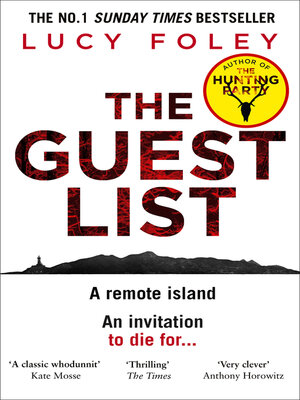
Review of "The Guest List" by Lucy Foley

Review of "The Guest List" by Lucy Foley


Lucy Foley’s The Guest List is a character drama masked as a mystery thriller. The opening chapter sets up a murder mystery, but we don’t know who died until the end of the book. It allows suspense to build throughout the novel. The story is set on a secluded Irish Island with caves and graveyards during a storm. The setting creates an eerie atmosphere that helps heighten the tension of the mystery.

Foley’s writing blends classic whodunit elements with modern suspense that focuses on the characters. The narrative is told from multiple character viewpoints. The switch between characters adds to the chaos of the mystery. Each character carries secrets, grudges, and hidden motivations, making everyone a potential suspect. With every new chapter the characters reveal a small part of the larger picture that leads into the mysterious death.

One of the novel’s greatest strengths is its setting. Foley uses this claustrophobic environment to great effect, crashing waves, looming cliffs, and unpredictable weather mirror the emotional storms. Jealousy, betrayal and guilt fuel the guests motives and create controversy amongst each other. The author skillfully examines how long-buried resentments can lead to conflict with others and unfortunate consequences.

While this book might be a slow burn, it keeps the reader engaged by constantly layering the character drama and making us sympathetic with some characters and disliking others. Several times throughout the novel I thought I had guessed who the murdered victim would be only to change my mind repeatedly, truly leaving the end a mystery.

However, the book does fall into certain narrative traps, such as having characters hide information for someone for no reason. Or having certain characters not knowing each other, when it seems like they probably should have based on their friendship circles. But without those tropes there would be no mystery, it would just be a murder.

Overall, The Guest List is a compelling, tightly plotted novel that delivers twists, tension, and a satisfying payoff. Foley delivers a solid suspense novel that balances atmosphere, with character development, and mystery. I don’t think this book would be for everyone, because it is character driven and a slow burn. But if the plot seems intriguing to you, then I recommend giving this book a read.